Sunday, January 29, 2017

So What's Up With?: Turkey

The world is a little crazy right now, and due to the brevity preferred by the modern 24 hour news cycle, a lot of people remain curious about WHY events are happening. I frequently find myself or my historian friends being asked to explain the historical context of certain events, and I thought a series of posts talking about the history of certain countries or groups by be interesting or useful to some of you. These posts aren't meant to be all-inclusive, and I'll be skimming over, simplifying, or leaving out information simply to keep things short. I'm also going to endeavor to keep things apolitical by sticking to the current consensus among historians on a given topic. Today we'll be starting with Turkey; it's been in the news a lot and it's the country I specialized in as an undergrad, so it seemed like an obvious place to start!


1. The Ottoman Empire: So What's a Turk?

The modern Republic of Turkey is the successor state to the Ottoman Empire which ruled most of the Middle East from the late Middle Ages until the early 20th Century. The founders of the empire were Turks; a tribal group who originated in modern Central Asia and Mongolia. Taking advantage of instability in the wake of political turmoil in the Islamic world, devastation left by the crusades, and weaknesses in the aftermath of the Mongol conquests, more and more of these Turkic peoples began moving south into Anatolia and the Middle East.  The term "Ottoman" refers specifically to the ruling dynasty of the empire. The dynasty was founded in the early 1300's by Osman I, a Turkic tribal leader whose father had assisted another Turkish empire, the Seljuks, in their fight against the Byzantine Empire and been granted lands in modern Anatolia for his service. Slowly the Ottomans gained followers and conquered more and more lands, mostly from the Byzantines or other tribal groups.

The greatest extent of the Ottoman Empire, covering multiple modern nations. 

In 1453 the Ottomans finally took Constantinople. By 1683 the Ottoman state was at its apex; they controlled either directly or through tributary vassals all of North Africa, Egypt, Anatolia, Greece, the Balkans, the entire Black Sea coast, most of Mesopotamia, and significant portions of the Arabian Peninsula including the holy cities of Mecca and Medina. They were successful for several reasons; the empire was relatively tolerant, allowing them to rule a diverse empire composed of hundreds of ethnic and religious groups without too much instability. Their government was well structured and centralized, and in many ways quite modern for its time with a system of local governors reporting to regional heads who in turn reported directly to the government in Constantinople. Their leaders were also extremely effective; ANY son of the previous sultan could become heir, so usually all of the potential heirs would spend years plotting against and assassinating one another to take power, giving all excellent political experience early on and ensuring only the most brutal and experienced would succeed.  Most importantly, they had a modern, well organized, and well equipped military which was only stopped in 1683. In that year a massive Ottoman army laid siege to Vienna in Austria, but was crushed in the largest cavalry charge in history when nearly 20,000 heavy cavalry from Germany and Poland surprised the Ottomans from behind and annihilated their largest field army (this event inspired the Battle of Pelennor fields from The Lord of the Rings !).

Until they were dissolved in 1826, the Janissary Corps served as the Sultan's elite professional slave soldiers.

2. The Sick Man of Europe

Things really started going downhill for the Ottomans in the 1700's. The European powers grew more centralized and their armies became more professional. The Ottomans began to suffer economic problems as well; their control over eastern trade routes became less and less relevant as European sailing technology and focus on the Americas increased. Partly due to their success the government also became increasingly conservative and resistant to change, and by the late 1800's things were in dire straits for the Empire. They had lost a number of humiliating wars against western powers (beginning with Napoleon in 1798), especially Russia. They were also suffering internal problems as the government became more and more oppressive and nationalism grew among ethnic minorities. Egypt was effectively lost to the British in the mid 1800s, Greece and several Balkan nations gained their independence and ethnic and religious unrest began to break the empire apart from the inside.

Napoleon's campaign also sparked European interest in Ancient Egypt, and created huge demand for
Orientalist art. 
Punch Magazine cartoon parodying Sultan
Abdul Hamid II, showing hims as so
incompetent that he learns of his Empire's
reorganization from a posting resembling
an eviction notice. 
 Desperate for to regain their prestige and to force the Sultan to follow through on earlier promises of constitutional reform, a group of young Turkish intellectuals and army officers staged a revolution in 1908. This brought an end to the autocratic rule of the Sultan, but replaced it effectively with a dictatorship led by Young Turk leaders who paid lip service to the Sultan. Despite some early government and military reform successes, the Ottomans continued their decline; after suffering humiliating defeat in the Balkan wars and losing their remaining North African influence to Italy and France, the dictators of Turkey known as the Three Pashas began seeking a European alliance to help them recover their lost prestige and territory. They found their ally in thew newly formed Empire of Germany. The alliance was convenient for both sides for several reasons.  Germany was in a rivalry with England, France, and (especially important to the Turks), Russia, all of whom had expressed colonail interest in current or former Ottoman territory. The Germans hoped the Turks would be able to form a southern front against Russia in a theoretical war between the great powers, while the Ottomans hoped that Germany would be able to give them the decisive military edge to defeat their hated northern rivals. The alliance was formally ratified on August 2, 1914; 2 days later Germany's invasion of Belgium brought France and England into the First World War. Germany would become a massive arms and equipment supplier to the Empire throughout the war, and provided both officers and training to the outdated Ottoman military.

3. The War

World War I was a disaster for the Ottoman Empire. They managed to win a few victories (notably against the British Indian Army in Mesopotamia, modern Iraq), but spent most of the war on their back foot. For decades Arabs within the empire had been discriminated against, with even Arab officers in the Ottoman army frequently insulted, used in suicidal attacks, or sent to isolated garrisons with no chance for advancement. Arab nationalism had been on the rise as a result, which the British began to use to their advantage. Spurred by Anglo-French promises of an independent state, and made confident by British training and equipment and Entente promises of liberty, the Arab revolted cutting the empire in half. With the help of western advisers like Lawrence of Arabia and with British deliveries of weapons and explosives, the Arabs became a constant drain on the Ottoman war effort beginning in 1916.

Arab soldiers during the war. In addition to the Bedouin guerrillas made famous by Lawrence of Arabia, the Arabs
did employ a professional army trained, equipped, and largely led by British and French officers. 

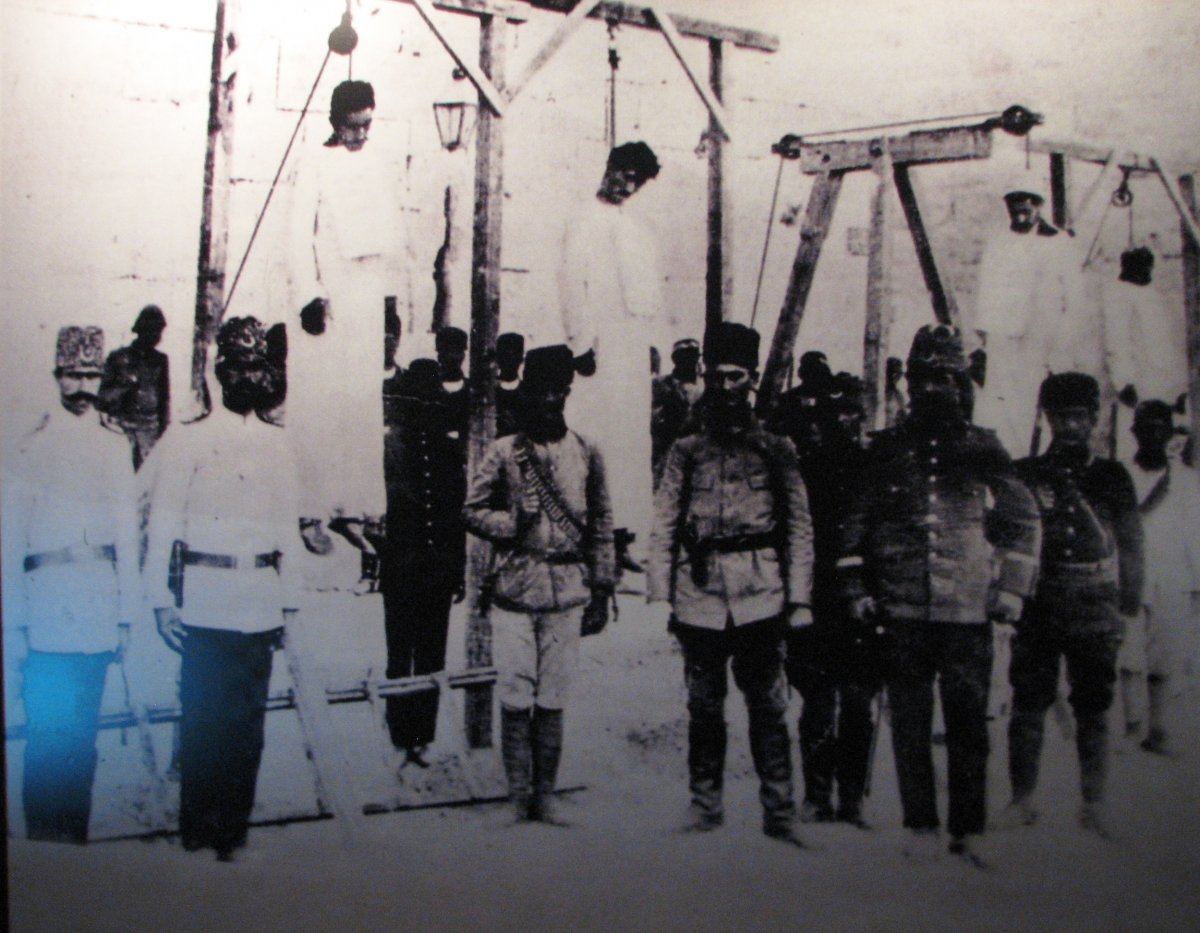
Ottoman officers pose with hung Armenian doctors in
Aleppo, 1916. 
Meanwhile, in 1915, the Armenian Genocide had begun. In brief, a combination of instability caused by Armenian nationalists, Turkish prejudice, and worry that the Armenians could act as a dangerous Christian fifth column  caused the Turks to begin mass deportations and killing of Armenians. The genocide itself remains controversial and extremely complicated, but in short perhaps as many as two million Armenians were killed or died as a result of these killings and deportations. It also infuriated western nations, and relevant to this discussion, has caused continual international tension with Turkey and her neighbors to this day. The modern nation of Turkey does not recognize the Armenian genocide. I won't get into all of the details here, but in general most Turks acknowledge that massacres took place, but do not believe that the killings were an attempt at systematic eradication and do not believe that as many died during the genocide than is usually estimate. Further some Turks (including the current government) state that due to instability and violence caused by Armenian nationalists in the years leading up to the war, the deportations and executions were justified but botched by a handful of incompetents. This, as you might expect, is seen as extremely offensive to many nations, especially in Armenia and in nations with large Armenian expat communities.


The battles of the war were mostly disasters for the Ottomans, who suffered loss after loss. This was
especially true in the Caucuses. Enver Pasha, one of the Young Turk leaders, drew up a plan to attack Russia through the Caucus mountains and regain territory. Despite thinking himself a military genius, the attack was made in harsh terrain in winter the the Ottomans suffered appalling casualties from which the Ottoman military was unable to recover. Liman von Sanders had a poor opinion of Enver; not only was a he not a genius, von Sanders believed that Enver was actually dangerously incompetent and the two clashed frequently over matters of military policy.  I should also note here that, due to his central role in the Armenian Genocide, Enver is an extremely controversial and loathed figure to this day. In Turkey after the war Enver and Mustafa Kemal also became political and military rivals, and eventually Enver was exiled. He wound fighting in the new Soviet Union, attempting to establish a Turkish state in the Muslim majority areas of the country. While fighting he was killed by Red Army troops in 1922.

Mustafa Kemal at Gallipoli
The one bright note (from the Ottoman perspective) during the war was the Gallipoli. The entente decided to knock the Ottomans out of the war by attacking Constantinople during the Dardanelles campaign, a plan which First Lord of the British Admiralty Winston Churchill championed. Thanks to the brilliant leadership of local leaders, particularly a young officer named Mustafa Kemal, the Turks inflicted huge casualties on the British fleet and the predominantly Australian, New Zealander, and British Indian Army troops who were landed on the Turkish beaches. Kemal became a national hero, a role which was further reinforced in 1918. As the broken Ottoman army retreated from Arabia and the Levant, Arab and British forces harried their fleeing foes. Kemal managed to keep his 7th Army intact and formed them into a defensive line around Aleppo which he was able to hold until the war ended. Nearly all other Turkish forces in the area, including the 8th Army, were destroyed almost to a man.


4. The False Peace
The peace which ended the war had massive ramifications for the future of the world. In the Middle East, the Entene reneged on most of their promises; far from granting the Arabs their own large national state, the victorious western powers carved the former empire up. Britain cemented its hold on Egypt and the Sinai, and also took Palestine and Mesopotamia (modern Iraq). France took Syria and occupied southeastern Anatolia. Greece was given a large part of Thrace, including the historic Ottoman capital of Edirne, as well as numerous Aegean islands and a strip of the Anatolian coast around Izmir. Armenia became a fully independent nation, and Italy occupied most of Southwestern Anatolia. Most humiliating for most Turks, a strip of land around the Dardanelles (the area which the Turks had so successfully defended throughout the war) was occupied by an international coalition, as was the capital at Istanbul. The treaty went into effect in 1920 and despite never being formally ratified, had huge repercussions which can still be seen today. The treat laid the groundwork for the formation of the modern state of Israel (which would grow out of the British mandate in Palestine), and formed most of the borders that modern Middle Eastern countries conform to.

Partitioning of the Empire. Most Arab areas south of this went over to British control. 

 While most Turks realized that the empire was lost forever, the occupation by foreign troops was unacceptable, particularly in the capital and the Dardanelles where so much bled had been shed. Mustafa Kemal, who since the end of the war had served in a number of roles reorganizing the defeated military, quickly decided to take action, In June 1919 he issued a declaration which stated that, as a result of the partitioning and occupation of the country, Turkish independence was at risk. A month later he resigned his commission, putting him in danger of execution both by occupying authorities and the rump Ottoman government. In September he assembled a congress in Sivas, one of the few cities not to be occupied, and at this meeting the delegates elected him to be effectively the head of the executive committee of the congress. In December the final parliamentary elections of the Ottoman Empire were held, and Kemal's party took a majority of seats; in early 1920 this body was finally dissolved by the occupying British.

As a result of this, Kemal called for new national elections to create a Grand National Assembly. When this assembly met in 1920, it essentially created a second government for Turkey, as the occupying powers still recognized the Ottoman government led effectively by Grand Vizier Damat Ferid Pasha who signed the above treaty. This enraged the GNA members, and Kemal called for the assembly of an army to defend Turkey.

5. War of Independence

Early on, Kemal's forces appeared to be in dire straits. In the west they were opposed by the remaining Ottoman loyalist armies, backed up by the occupying Entente forces while in the west they were also facing the new Armenian army, who had occupied territory granted to them in the treaty but which the GNA did not recognize as theirs.

Turkish leaders during the War of Independence. Mustafa Kemal is in the front row, third from the right. The man fourth from the left in the funny hat is a Soviet military adviser. The Soviets pumped resources into the war hoping to keep the area unstable and perhaps leaving it open to Communist revolution. 

Turkish soldiers in a trench before the
battle of Dumlupinar. 
The war which followed, the Turkish War of Independence, raged until late 1922. After successfully invading
Armenia and reclaiming disputed territory, the GNA faced an invasion from Turkey as they moved to occupy the areas in western Anatolia they had been granted at the end of the war. On August 5, 1921, after the Greek army was only 80 kilometers away from the frontier held by GNA forces, Mustafa Kemal was appointed as Commander in Chief of all GNA forces. After halting the Greeks at the Battle of the Sakarya River, the allies sought to negotiate a modified but still punishing version of the treaty with the GNA government (now based in Ankara), but they were refused outright. Later that same month Kemal launched a sweeping attack on the Greek occupied territory in Anatolia. On August 30 1922 the Kemal's forces swept the remaining Greeks out of Anatolia in the Battle of Dumlupinar, and his forces regained control of the city of Smyrna by September 9. The next day Kemal sent a telegraph to the new League of Nations, informing them that the Turkish population of the country had been so humiliated and enraged that he could not keep them under control.  Now facing both a well-organized and led national army as well as the prospect of a brutal insurgency, the western powers sought peace and the GNA gained formal control of Turkey.

6. The Republic of Turkey
On November 1, 1922, the GNA's newly founded parliament abolished the sultanate and the Ottoman Empire ceased to exist. The Treaty of Lausanne, made with the occupying powers, established the recognized sovereignty of the new state and finalized its borders. On October 29, 1923 the Republic of Turkey officially came into being, with Mustafa Kemal as its first president and Ankara as its new official capital.

Ataturk during his presidency
Kemal began an aggressive campaign of reform, modernization, and westernization. Traditional forms of
dress such as the fez were banned. Women were given political and civil rights unheard of up until that point. The writing system of the Ottomans had been based on Arabic, but writing in the Turkish language was clunky with this alphabet due to certain sounds in Turkish. Therefore, it was replaced by a new system based on a modified form of the western Latin alphabet. The country was secularized, and a firm division of church and state was established, while things like alcohol and freedom of religion were instituted. All Turks were also expected to take on a surname in the western style; Mustafa Kemal was granted the surname "Ataturk" by parliament, meaning Father of Turks in 1934. By the eve of the Second World War Turkey had made large strides in modernization, though it remained functionally a dictatorship first under Ataturk and then under his successor Ismet Inonu, until the latter was defeated in free elections in 1950.

Ataturk's legacy cannot be understated when trying to understand modern Turkey. Thanks in part to a personality cult which was fostered around him during his long presidency, and in part thanks to the belief among Turks that he saved the country from becoming a victim of colonization, Ataturk remains wildly popular today. Laws exist prohibiting the insulting of Ataturk (in a country with otherwise fairly liberal free speech laws), and every house, business, bus, and building has a photo of the man.

The author took this photo in 2008. It shows a massive photograph of Ataturk flanked by Turkish flags over looking the city of Istanbul from a nearby hill. 

7. A World at War

Izmet Inonou, leader of Turkey in WWII
During World War II, Turkey remained neutral and profited from both sides. After the First World War ties
with Germany had been close, and the Nazis attempted to rebuild the old alliance but to no avail. Despite this, the two nations remained firm trading partners. In 1939, unsure of Hitler's intentions, Turkey signed a pact with Britain which stated that Britain would come to Turkey's aid in the event of a German attack on Anatolia, but this never happened and Turkey remained an important supplier of Chrome and other materials to both the Axis and the Allies. In August 1944, when German defeat was unavoidable, Turkey broke off relations and began growing closer to the allies. In February of 1945, only months before the end of the war in Europe, Turkey declared war on Germany and Japan (Italy had already been defeated). While Turkish troops never saw combat, they did continue to supply the allies and this allowed Turkey a seat at the table in the formation of the United Nations.

During the War of Independence, the GNA had received supplies and money from the Bolsheviks, who had hoped to cause further instability among the western allies. However, beginning in the 1930's under Stalin the Soviet Union became increasingly aggressive and relations between the old rivals worsened. After World War II, the Soviets even went as far as demanding the establishment of Soviet naval bases on Turkish soil, especially in the straits around Istanbul. Worried about growing Soviet influence, American President Harry Truman gave a speech on March 12, 1947 which established the Truman Doctrine. This doctrine would provide massive military and economic support to Greece and Turkey, and implied support for other nations as well. The speech is often considered to mark the starting point of the Cold War, and Turkey was at its center.

Turkish soldiers in Korea during the war. The Turks were supplied with American equipment and fought under American command.  
The United States kept its word, and money and military equipment flowed into Turkey. Turkey was a loyal ally; in 1950 the Republic sent forces to aid the United Nations forces in the Korean War. At the Battle of Wawon, the Turkish Brigade led a rearguard action which slowed the North Korean army and cost the brigade dearly in the loss of men and equipment. At the battle of Kunuri the brigade lost 15% of its combat strength. Then at the battle of Kumyangjang-Ni in January 1951, the brigade saw off a Chinese army  more than three times its size. The unit received the Distinguished Unit Citation from the United States, and by the end of the war 721 Turks had been killed and more than 2,000 wounded. In acknowledgement of their contribution, Turkey was invited by the United States to join NATO, which they did in 1952.

Throughout the Cold War, Turkey remained a critical ally of the United States, which began establishing air bases in the country. In 1962, the United states began deploying Jupiter ICBM's equipped with nuclear warheads in Turkey. Concerned and needing a show of Force, Soviet Premier Nikita Khrushchev began the construction of Soviet missile cites in Cuba, leading to the Cuban Missile Crisis (that's right, despite most high school level history courses implying the Soviets were responsible, we built threatening nuke bases first!). At the peaceful conclusion of the crisis the missiles were withdrawn, but American troops remained in country.
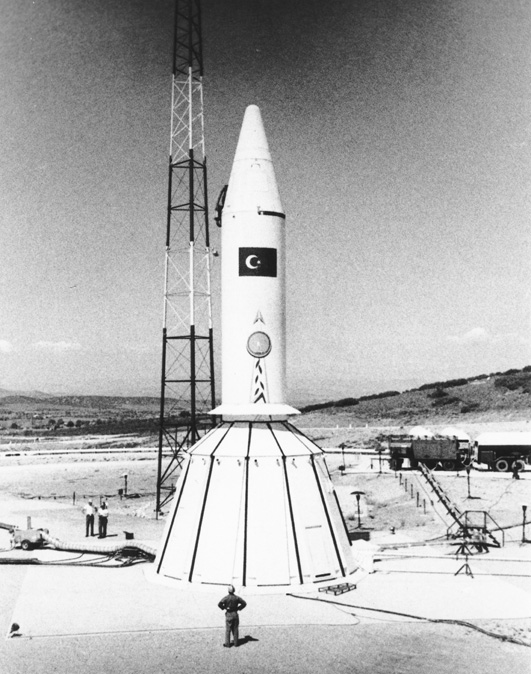
American Jupiter ICBM in Turkey in 1961, bearing a Turkish flag. 


In the 1950's, the Greek and Turkish populations of the island of Cyprus began having increasingly heated ethnic tensions which turned into violence. In 1974 the military Junta in Greece managed to stage a coup on the island with the aim of an annexation of the island to Greece down the road. Concerned about naked Greek aggression, and justifying themselves by claiming they were protecting the Turkish minority on Cyprus, Turkey invaded the island and established a Turkish puppet republic. The republic exists today and Cyprus remains divided, though only Turkey itself recognizes the Turkish Republic of Northern Cyprus today. The invasion and subsequent occupation was criticized by most world governments, and the issue remains a sticking point in Turkish foreign relations, particularly with Greece and the European Union.

Map showing the ethnic population distribution between Greeks and Turks on Cyprus before the 1974 Coup and today. 

8. Turkish Coups
Despite the establishment of a multiparty republican democracy in Turkey after World War II, the country has faced periods of instability. Turkey has seen three successful and several unsuccessful coup attempts. The first, in 1960, was staged by Turkish military officers who had been trained in the United States. Truman Doctrine money was running low, and the then prime minister Adnan Menderes had planned to visit Moscow. This led to fears that he was attempting to realign the nation towards the Warsaw pact and the military intervened. Menderes was executed for treason, and the military effectively controlled the nation until 1965. In 1971, facing internal strife and an unpopular government, military leaders issued a "coup memorandum" warning the civilian government to improve the situation, which led to the fall of the then-current administration. In 1980 General Kenan Evren staged another coup. Martial law was established and despite handing the government back to civilian authorities two years later, the military continued its effective control of politics for some time after.
Adnan Menderes and his staff are arrested by Turkish military police. Note that the Turkish military is still using mostly American equipment and weapons. 

The remainder of the 1980's were a flowering period for Turkey; under the leadership of Turgut Ozal and his Motherland Party the economy was liberalized and the standard of living for the average Turkish citizen improved dramatically. However, the Motherland party also advocated certain conservative social values, which some argue opened the door for radical Islamist sympathizers who until then had been virtual pariahs in the Turkish political stage.

PKK Kurdish rebels pose with their Communist-Inspired
flag in the Turkish city of Diyarbakir in 2015. 
During the 1980s the conflict with the Kurds truly began as well. The Kurds had been an ethnic minority throughout the Ottoman period, and had faced periods of repression and growth during the Republican period. With Turkey's entry into NATO, the Soviet Union began equipping and training Kurds in an effort to destabilize Turkey. However, the situation remained fairly stable until the 1980 coup, when Evren's military government launched a brutal crackdown on leftist organizations and individuals, especially in Kurdish areas. This led to a series of Kurdish terrorist and military attacks on Turks, and the conflict has been going on ever since. The Kurds and particularly the PKK are seen by terrorists by many Turks, especially as they have historically depended on suicide and IED bombings, hostage taking and kidnapping, and guerrilla attacks on Turkish conscript soldiers and police officers. The Kurds meanwhile see the Turks as an oppressive occupying force bent on preventing Kurdish independence. Both sides have committed atrocities, and while things began to calm down in the 2000's, the rise of ISIS has reignited issues on the border.

In 1987 the southeast of Turkey was put under emergency martial law in part due to increased conflict with the Kurds. Turkey was politically unstable throughout the 1990's, and things came to a head in 1997 with Necmettin Erbakan's government. He was accused by the military of supporting Islamist policies which were counter to the secular law of Turkey, leading to his resignation to prevent another coup. Several political parties were banned in the aftermath, and in 1999 a coalition between a center-left and far right nationalist party formed a government which instituted economic reforms and human rights legislation, but which was mostly ineffective due to the radically differing ideologies of the two parties forming the coalition.

9. Turkey Today

In 2002 the former Mayor of Istanbul, Recep Erdogan, came to power at the head of the Justice and Development Party (the AKP). The party has won every election since, but has become increasingly controversial abroad. Turkey attempted to join the EU in the early 2000's, but due to human rights and economic issues Turkey was rejected and its bids to join the EU since then have stalled. EU leaders cited a draconian justice system, government instability, economic issues, and human rights abuses against Kurds and other minorities as reasons for the rejection, though some Turks saw it simply as a matter of western arrogance or racism.

Erdogan, the current leader of Turkey
The AKP has continued to improve the economy of Turkey, but has become increasingly totalitarian. Several alleged coup attempts have taken place since they came to power, but many view these as excuses for the party and Erdogan to simply liquidate rivals or threats to their power. The party relies heavily on the rural vote in Turkey, and has begun to increasingly use Islamist language of a type not seen before in mainstream Turkish politics. Due to Ataturk's major emphasis on secularization, Turkish politics and religion have long been heavily seperated, but the AKP has begun to break some of these barriers down.In 2013 protests erupted in the Taksim neighborhood of Istanbul as young people gathered to show their support for Turkish secularism and democracy. The protests were brutally put down by riot police, and 11 protesters were killed. This was the first time that many westerners became familiar with the increasing repression faced by the Turkish public.

Riot police attack Turkish protestors

In 2016, a coup was staged citing increasing censorship and a breakdown of secular values in government. This was easily put down, and some commentators believe that the coup was actually a false-flag operation to allow Erdogan to take more firm control of the government. Since the coup a series of purges have been launched which have resulted in the firing or arrest of hundreds of thousands of politicians, teachers, academics, civil service workers, and journalists. Amnesty International claims that many of these have been victims of torture while under detention, and many have been charged with belonging to terrorist groups on clearly fabricated evidence.

Turkish citizens pose on a surrendered tank in the aftermath of the failed 2016 coup attempt in Istanbul. 

Turkey's traditional 20th century alliances have also begun to break down. This really started in 2003 with the American invasion of Iraq. Erdogan's government refused to allow American forces to use Turkey as a launching off point for ground attacks, or even as a launching point for bombing and aircraft missions. In the wake of the instability after the invasion, Turkey saw an increase in problems with Kurdish militant groups, some of whom were armed by the US to fight the Iraqi insurgency and others who know had more breathing room now that they could retreat into a less hostile Iraq. Turkey did eventually commit troops to Iraq for peacekeeping purposes, but the strain between the Us and Turkey remains.

Turkish artillery in firing positions on the Syrian border. 
The Arab spring in 2012, the Syrian civil war, and the rise of the Islamic state have further complicated matters in Turkey. Erdogan's government has been accused of supporting Islamist groups in Syria either directly or by funding them indirectly through the purchase of oil from Islamic State held refineries. Turkish troops have also skirmished with Russian forces operating to support the Assad regime, and Turkish-trained and backed militias have shot down Russian aircraft, killing pilots. Despite this tension with her old rival, Turkey seems to be moving closer to Russia as Erdogan looks for alternatives to the United States.

Conclusion

Andrei Karlov lies dead behind his
shouting assassin, 2016. 
As you can see, Turkey has an incredibly complex history. Despite its status as one of the oldest
democracies in the Muslim world, it is constantly threatened by ethnic strife, nationalist movements, religious extremists, militant religious groups, and the strategic needs of foreign powers. Currently the Erdogan government is becoming increasingly repressive, even as Ankara and Istanbul suffer attacks from Islamic extremists. As the meeting point of the Middle East, Europe, and Russia, Turkey finds itself in dire straits. Most recently, in December 2016 an off-duty Turkish police officer assassinated Andrei Karlov, the Russian ambassador to Turkey during a press conference in Ankara. The assassin shouted Islamic mottoes and called on witnesses to "remember Aleppo" (in reference to Russian bombings in that city), but Russian President Vladimir Putin claimed that the assassin had been motivated by an urge to damage Turkish-Russian ties.

I'm not sure what the future holds for Turkey, and it's difficult to say where it is going to go. While becoming increasingly sympathetic to Islamists, Turkey is also strengthening ties to Russia. At the same time, only hours before this article was posted, Turkey agreed to sign a multi-million dollar arms deal with Great Britain. Pundits have also noted that Turkey looks forward to better relations with the United States under President Trump, despite Erdogan's criticism of Trump's policies on Muslim immigration. Turkey is complex and fascinating, and hopefully you have a little bit more of an understanding about their current and historical political situation and why they seem so unstable today.

Further Reading

Lord Kinross, Ottoman CenturiesThis book, while a little older, is still considered the gold standard for a basic, in-depth look at the history of the Ottoman Empire.

Caroline Finkel, Osman's Dream: The History of the Ottoman Empire. This is essentially an in-depth chronology of the Ottoman Empire. It offers little analysis, but is good to get a more in-depth look at the empire.

Carter Findley, The Turks in World History. If you want an extremely detailed look at the history of the Turks, then look no further. This is a fairly advanced read geared more towards academics, but it's worth a look if you have a serious interest!

Eugene Rogan, The Fall of the Ottomans: The Great War in the Middle East. This is my favorite book on the final years of the Ottoman Empire, Rogan does a great job of mixing both political and military history and manages to keep things fairly simple.

Andrew Mango, Ataturk: The Biography of the Founder of Modern Turkey. There are a lot of Ataturk biographies out there, but I like this one because it manages to stay relatively unbiased and is detailed without being an extremely difficult read.

Stephen Kinzer: Crescent and Star: Turkey Between Two Worlds. A great book on modern Turkish history, this is updated fairly regularly with new editions to boot!

Andrew Finkel, Turkey: What Everyone Needs to Know. If you want a much more detailed, longer version of the post you've just read, this is the book for you!


Friday, November 25, 2016

Herr Krampus

In recent years, the question I get from everyone who knows that I grew up in Germany has become "what's up with the Krampus?" He's become increasingly featured in pop culture, and even starred in his own horror-comedy film last year. So what IS up with the goat legged German Christmas monster?

Guten Abend!

As a note, it is just Krampus; there is no "the" before it, as Krampus is his name. It's related to the old Germanic word for claw, which gives you some idea as to his nature! I should also note that in many regions of Europe, Santa Claus and St. Nicholas are two distinct beings and the names are not interchangable as they are in the United States. In Germany therefore you have both Sankt Nikolaus and Der Weinacthsmann (literally "the Christmas Man") who have different jobs and responsibilities. Krampus is sometimes represented today as a companion of the latter, but usually and traditionally he is solely associated with the religious figure of St. Nicholas and his associated holiday traditions.

The Mythology

Mwahahahah.... I mean, Ho Ho Ho!

So in much of Europe, St. Nicholas has specific, named helpers. It's from these helpers that we probably get the American idea of Santa's generic elves. In every region these companions are different; in some regions he has only one, in others he has many, but they tend to fall into a few archetypes. The two more common are the Christmas helper, who acts as a benign figure helping the Saint, and the "anti-Saint", usually a figure who punishes or scares bad children. These figures act as the negative reinforcement to St. Nicholas' positive reinforcement, and perform a role that you might associate with the boogeyman in the English speaking world.


Krampus is most definitely the latter, and is by far the most fearsome. Krampus is half demon, half goat, and resembles the Greek Satyr with a long tongue, covered in chains, and wielding a bundle of branches. The mythological origins of Krampus vary, but I'll share the one I heard most often while visiting the Alpine regions of Germany and Austria as a kid. The story goes that one day while travelling, St. Nicholas encountered a ferocious demon, the son of the Norse Pagan god Hel. The beast challenged the Saint to a spiritual battle, and each agreed that they would serve the other if they lost. Nicholas defeated the demon handily, and instead of simply banishing him, decided to put his wicked skills to use for the greater good. He bound the demon, Krampus, in chains, to serve him for all time. Other origins claim that the two are simply opposite sides of the same coin, or that Krampus follows St. Nick willingly.

On December 5, the eve of St. Nicholas' feast day, the Saint and Krampus appear. This night is often referred to as Krampusnacht, or the Night of Krampus. Usually, the duo have been "at large" since the feast of St. Martin (Martinstag in German, on November 11), but appear to begin their duties on the night of the 5th. Children are visited by the Saint, who gives them small toys, fruit and candy if they have been good, or leaves gifts in their shoes (left by a door or window) after they fall asleep. If the children have been bad though, they do all they can on this day to reform their ways in hopes of avoiding the notice of Krampus.

You REALLY want to avoid his notice...
If a child has been wicked and remains unrepentant, they are visited by Krampus. His punishments are harsh but just, and vary according to the level of evil the child has committed. He may simply give them coal, much like our Santa Claus. If they have been very bad, he will use his bundle of birch sticks, called the Ruten in German, to savagely beat the child to convince them to reform their ways. Children who are in between these extremes may have a Ruten given to their parents instead as a warning. And the worst children receive the worst punishment of all; the Krampus will bind the child in chains, stuff them into the sack he carries on his back, and drags them to the hellish domain to be punished by beings far worse than Krampus himself!

The Traditions

In addition to being used as a threat by flustered parents, there are more tangible Krampus-related traditions. The most famous is the Krampuslauf, or Krampus Run, a type of Krampus-themed parade and gathering. The young men in a village or neighborhood will don handmade Krampus costumes, carefully built during the preceding year, and march or run through the village rattling their chains and being frightening. They can be bought off by offering them schnapps, and by the end of these events the young men are normally well and truly drunk and are chasing their sweethearts and crushes instead of the local children.


During the holidays a  person may visit homes, schools or businesses dressed as St. Nicholas, and he might in turn be accompanied by a Krampus. The Saint will hand out candies or fruit (oranges are traditional), while the Krampus will make fearsome noises and hand coal or Ruten to parents with a wink. These events are most common on the 5th of December, but may occur at any time between the feast of St. Martin (November 11) and Epiphany in January, a period broadly defined as the Christmas season in southern Germany and Austria.

Vintage Krampus

These gatherings were banned during the Nazi era, when the drunken parties that devolved from the Krampuslauf were seen as a threat to public morals. In Germany, Austria, and surrounding areas Krampus' popularity has waxed and wained over the years. When I was a kid it had become more of a rural tradition, but in recent years Krampus has begun to make a comeback with his growing recognition in popular culture. With that said, Krampus has also become controversial in German-speaking countries in recent years, with some questioning the appropriateness of telling such fearsome stories to young children. However, most people agree that Krampus and other "evil" companions of St. Nicholas serve an important purpose as tools for punishment and discipline.

Traditional Krampus Card. The bottom "Gruss vom Krampus" means "Greetings from Krampus" and is the most
commonly featured phrase on these cards. 
In addition to these gatherings, Krampuskarten, or Krampus themed Christmas Cards, have been popular in German-speaking countries since Victorian times. These cards come in a variety of forms; some feature a serious, frightening Krampus, but usually they are more lighthearted. They are often humorous and may feature bawdy humor; Krampus chasing buxom maidens, raunchy poems, and other adult themes are popular. In recent decades "cute" Krampus cards have begun to appear, featuring a Krampus who is cartoonish and more kid-friendly.

Stupid Sexy Krampus! 

The Origins

So how did all of this come about? Nobody is really sure to be quite honest, but most scholars agree that Krampus grew out of traditions from before the coming of Christianity to Germany. Horned animal gods were common motifs in in mytholoy and religion in ancient Germany, and the creation of the Krampus myth may have served to demonstrate the power of the Church over these older gods or devils. Young men dressing as demons or beasts to cause mischief or celebrate festivals became popular in Europe during the high Middle Ages, and the current Krampus traditions probably date to around that time.

Norse-Germanic Horned God featured on a cauldron found in Northern Jutland.


Other Christmas Companions

As noted above, St. Nicholas has lots of companions which vary by region. Here's a few of the more notable ones.

Belsnickel: This guy is popular in Southern and Western Germany, and was featured as a joke in the American version of "The Office". This is the companion that was most common in the region of Germany where I grew up, and I only became familiar with Krampus after our family would travel to Austria for Christmas with a family friend. He's a fearsome figure, but much more friendly than Krampus, and I often compare him to a mix of Hagrid from Harry Potter and Krampus. He's a large bearded figure who may give candy or sweets, or coal or switches, depending on how good a child was, and usually arrives separately from St. Nick. Before Krampus became popular in the US, he was probably the most well-known companion, with certain communities in Canada and the American midwest (especially the Pennsylvania Dutch) retaining the tradition.

Dwight Schrute on The Office playing Belsnickel. He's shockingly accurate!


Zwarte Piet: Zwarte Piet is a sort of generic servant to St Nicholas popular in the Netherlands and Belgium. In recent years the character has became a huge center of controversy, because he is normally portrayed by a white European wearing a renaissance-style costume featuring blackface makeup. The reason for this is varied; some say Zwarte Piet is shown this way to represent to soot he's covered in from going down a chimney, while others say that he first appeared as a Moor, a medieval word used to describe black North Africans. I won't get into the controversy here, but due to the connotations of Blackface in the United States (connotations not necessarily associated with Blackface in Europe) the figure has never become as widely popular as other Companions.

Seriously, I'm not touching this one

Knecht Ruprecht: Usually portrayed as an elderly monk, shepherd, or farmer, Knecht Ruprecht is a generic manservant to St. Nick. He's common in the Black Forest Region and sometimes appears alongside Belsnickel whom he somewhat resembles. He will ask children if they know their prayers or if they will sing him a song. If they answer positively they receive fruit and nuts, and if they answer negatively or refuse to sing may be punished.


Perchta: This witch isn't necessarily a companion of the Saint, but she often appears at Christmas and women wanting to take part in Krampuslauf will dress as this figure instead. In Germanic peganism Perchta was a goddess, but since the coming of Christianity is usually portrayed as a witch or nature spirit. At midwinter she was said to roam the countryside, overseeing the spinning and sewing of young women. If she encountered good and kind children they would find a coin in their shoe or under their pillow the next day; if she encountered lazy or naughty ones she would slit their bellies open in their sleep. Yeah. And you thought Krampus was terrifying...

Some Percthen costumes resemble Krampus costumes, but it varies by region
Schmutzli: He appears in German-speaking Swiss tradition, and is similar to Belsnickel or Knecth Ruprecht. He wears browns robes and has a long white beard, and is often portrayed as the farmer who grows the fruit and makes the food which St. Nicholas hands out. At Christmas he herds the donkey or mule that the Saint uses to carry his gifts, and Saint Nicholas will sometimes call on the gruff Schmutzli to punish bad children.

Like Krampus, Schmutzli also carries Ruten. 

Any questions about Krampus or any of the other companions? Let me know, and behave or Krampus will find you!

Monday, November 7, 2016

Random Facts #6: The Madness of Marshal Blücher?

This is a topic I've wanted to cover for a little while, but never seemed to find the time. Every time I started to write the post it quickly spiraled out of control in terms of length, so I'm going to try something a bit different and do this as a "micro post" of only a few paragraphs. Maybe it works, maybe it doesn't!

If you've ever learned anything about Napoleon, you've probably heard of Generalfeldmarschall Gebhard Leberecht von Blücher, Fürst von Wahlstatt, normally known in English simply as Marshal Blücher. If you haven't a quick summary; Blücher served as a Prussian general during the Napoleonic Wars. After Prussia's defeat in the early part of the Napoleonic Wars, Blücher remained vehemently anti-French, and in 1813 assumed a command at the age of 71 to take the fight to Napoleon. He was instrumental in the Battle of the Nations which defeated Napoleon the first time. He became legendary during the Battle of Waterloo, when he led the Prussian forces which relieved the British under the Duke of Wellington to win the battle and defeat Napoleon for the final time.


Blücher is a favorite figure of many Napoleonic enthusiasts because he was, to put it mildly, a bit of an eccentric. After an uprising by Poles living in Prussian-occupied Poland, Blücher staged a mock execution of a priest for supporting the rebellion. This caused a public scandal, and officer was passed over for promotion. This prompted Blücher to write a nasty letter to the king, Frederick the Great (yes, THAT Frederick the Great), who in turn responded "Captain Blücher can take himself to the devil!" Blücher was nicknamed "Marshal Forwards" for his aggressive attacking style, and was no less interesting in his personal and civilian life. He was a notorious womanizer and gambler, in a country known for its austere sensibilities. In his later years he would write:

In my youth I cared for nothing except having fun; instead of studying, I gambled, drank, caroused with the ladies, hunted, and pulled hilarious pranks on my friends. That is why I now know nothing. Indeed, otherwise I would be a very different Chap!

In the 1970 film Waterloo, he was portrayed as a bit, let's say,
unhinged. 
Most famously though, are claims that in his later years he was actually mad, suffering from some sort of dementia or delusions, and it is this claim that this post addresses. These mostly seem to revolve around an anecdote which is popular among amateur historians, and I have seen it pop up in a number of those articles you see online discussing funny or weird historical curiosities. The problem though, is that it's based on a simple error translation and a cultural misunderstanding from the champions of such misunderstandings, the British.


Before the Waterloo campaign, after the Prussians' humiliating defeat to the French in 1806, Blücher suffered what we might now term as a breakdown or a panic attack. He held himself at least partially personally responsible for the Prussian defeat, and spent long hours alone in silence, but he would later recover and come to be a vocal critic of the peace with France. Then after his heroic effort in the winter of 1813-1814 he suffered another breakdown, this time related to exhaustion and stress, in the aftermath of his victory at the Battle of Laon. He was nearly catatonic for a week, but again would recover and come back to lead the Prussian forces to victory. It's clear Blücher was sensitive to stress and possibly suffered from depression, but given the difficult circumstances he faced one can understand this. Nonetheless, at the time these breakdowns, coupled with Blücher's general eccentricity, combined to give him a reputation for madness or dementia.

Blücher with his broken army shortly before his first breakdown

Things came to a head in the most famous case of Blücher's "madness" and one that is a popular anecdote to this day. I've seen this story repeated by history professors, in popular history books, and often online in articles discussing amusing historical events. Of course, it wasn't proof of madness, though on the surface it could certainly seem like that.

During the Waterloo campaign the elderly Blücher once again led his men against the hated French. Outside of Ligny they suffered a serious defeat, and his men broke in panic. Blücher was trapped under his dying horse, and he was run over by his own men and cavalry, and only avoided capture after an aide hid him under a coat. He was badly battered, and because they were in the field and time was of the essence (Napoleon was preparing to engage Wellington, who badly needed Blücher's help) the old field marshal couldn't recieve proper medical attention. An herbal remedy was applied to his wounds, and he fortified himself with liberal drinks of Schnapps. He then led his army in a torturous march towards the field at Waterloo.

Blücher defended by his aide after his horse was shot from under him at Ligny. 

The army followed muddy roads, and as they arrived late in the day Blücher was a site to behold. He was as animated as always while leading his men, referring to them as his children. He was dirty, covered in mud and his own blood, and still reeked of schnapps. The British leadership was, as you might expect, highly amused by the "mad" old Prussian general who had just helped them win the battle.

After the war, things were compounded in the most famous incident, as recorded by by Philip Henry, 5th Early of Stanhope who wrote a book of anecdotes and conversations the author had had with an older Duke of Wellington between 1831 and 1851. In it, Stanhope records a story which had already become somewhat notorious, presumably because it was a favorite of Wellington's. According to Wellington, during their last meeting in Paris in 1815 Blücher had completely lost it. He had been showing off for a group of English ladies (as he was wont to do) and had fallen from his horse, hitting his head. Later , before they parted, Wellington claimed that Blücher believed he was pregnant with an elephant! The specific passage can be found here.

A reserved Wellington meets a hilariously flamboyant Blücher in the aftermath of Waterloo

As a result, the story that Blücher believed he had been impregnated with an elephant by a French soldier became famous. The problem is, Blücher wasn't being literal and had simply directly translated a common German idiom into French. The fact that this was a metaphorical way of speaking was lost on the Duke, and most other English speakers at the time, and was taken at face value.

You see, the phrase "to be pregnant with an elephant by X" in German at the time simply meant that "X" was giving a person a problem, difficulty, or headache. What Blücher had done was made a joke; he had essentially said, "The French gave me such a headache. Can you believe it, French soldiers giving ME a headache?!"  This anecdote, shared by Britain's greatest living national hero, combined with Blücher's eccentric behavior, history of depressive breakdowns, and bedraggled and excited appearance on the field at Waterloo combined to give the old Field Marshal a reputation for madness that simply wasn't true.

Then again, without that reputation we probably wouldn't have gotten great cartoons like this, of Blücher viciously caning a tiny Napoleon. 
To learn more about Blücher, check out the the biography Blücher: Scourge of Napoleon by Michael Leggiere, probably the best single English source on the man today.

If you liked this format, or if you thought it was too short, please let me know! See you next time!

Monday, October 31, 2016

Halloween 2016 Post: The Odenwald Witch

In honor of today, I thought it'd be fun to do a post on something spooky. I had quite a few options, many of them inspired by my childhood in southwestern Germany, the birthplace of many of Grimm's fairy tales. I've decided to cover an incident which actually occurred to me in the spring of 2011.

I'll start with a few statements and caveats. Firstly, this story IS true to the best of my memory; I've simply omitted or consolidated a couple of points to keep things brief-ish. Secondly, in general I am not particularly superstitious and my belief in ghosts and the paranormal can be considered, at best, skeptical. I personally think that there's some sort of logical explanation for this incident, though what it would be I have never quite worked out for myself satisfactorily.

The Trip

In 2011 I took a year in between college and grad school to work and save some money. I also decided to use some of this cash to take a nice trip to Europe; the original plan was to spend nearly 2 months there. I would spend a week in my hometown of Heidelberg, Germany, and the rest of the time in France, Italy, Austria, Switzerland, and the UK. I grew up in a military family, and as a kid we moved a lot. Until I was almost a teenager we didn't spend more than a year or two anywhere, except for Heidelberg, and for that reason I have always considered it my childhood home. For reasons I will not get into here, I was forced to cut the trip down to a paltry two weeks shortly after arriving in Germany. I decided to cash in my rail pass, rent a car, and spend my time simply driving around southern Germany visiting friends, places we used to vacation when I was a kid, and generally relaxing.

Odenwald Fog (None of my photos of the day were this clear!)

The third full day of the trip, I had my plans squared away, and decided I'd venture into the Odenwald (more on that below). It's the region that Heidelberg sits in, and the more rural parts of it are full of small towns, castles, and some excellent hiking. My plan was to spend the day driving slowly along back roads from Heidelberg to the village of Michelstadt, a medieval town deep in the region that my family would often visit when I was a child. Along the way I had determined to stop at any locations or towns I thought looked interesting, get a little hiking in in the abundant woodland and small mountains, and generally enjoy myself.

My Odenwald road, just outside of Heidelberg. The fog grew thicker as the morning wore on

Odin's Forest

The Odenwald is a fascinating region of Germany, occupying a small patch covering several German states in the southwest of the country, near the French border. It's quite close to the Black Forest, and many people consider it a less touristy version of that region. It is mountainous and heavily forested, and the canopy, like that of the Black Forest, is so dense that the forest is often dark even in daylight hours. It's extremely beautiful, and if you like small villages, hiking, and medieval history I recommend visiting if you ever find yourself in the Frankfurt area.

The region has an extensive history; for nearly 100 years it made up the edge of the Roman Empire, and was one of the few regions of Germany settled by them. Several forts, camps, and bases there made up a section of the Lime Germanicus, the line of fortifications protecting the Romans from Germanic invasion. It was otherwise sparsely inhabited, until the Franks showed up and began building the regions first permanent towns and villages.

Me looking dopey in Michelstadt's town center, in front of the old guildhall.

The region has quite a history of violence; it's near the modern French border, sat in a border region between numerous small rival constituent states of the Holy Roman Empire, and due to the rivers, streams, mountains, and thick forests in the region it was highly defensible and ideal to build fortifications in. Towns in the region were frequently besieged, stormed, or sacked from the medieval period on, and saw fighting as late as the Second World War. This attention brought further dangers, and the region saw several outbreaks of plague and other diseases.

The origin of the region's name is a mystery, but there are several theories. Probably the most prominent, and the one I was told as a child by locals, is that the name mean's "Odin's Forest". Before the Romans came the area was supposedly sacred to Germanic barbarians who worshiped Wodan, the Germanic version of the Norse Odin. Local legend says that these early Germans sacrificed humans to their gods in the sacred forest by nailing them to or hanging them from the trees, and avoided the area for settlement due to its religious importance. This theory is hotly debated by modern local historians, but I think it adds another special layer of creepiness!

Anglo-Saxon depiction of Wodan/Woden, the Germanic version of Odin.

The region is also FULL of ghost stories and stories of the supernatural. The brothers Grimm mined the area for their work on folklore, and every town and hamlet has its own local legends. One says that a ghostly knight named Rodenstein rides through the forests at night with a band of barbarian berserkers whenever a war is going to break out. Others tell of appearances of the devil, who is said to rest on a particular rock or tree stump, beguiling travelers, making satanic deals, and leading people to their doom. The German mythological figure Siegfried was supposedly murdered in the area, and rumors of his ghostly curse abound. And of course, like any rural area in Germany, there are the stories of witches, the Hexen  who haunt the forests eating children and generally being a menace. Of particular Odenwalder flavor are the Wildweibchen, wild women who live in the forests. They are said to have power over men and animals and may be nature spirits, demons, witches, or some combination of all three.


The Ghostly Rodenstein begins his ride foretelling doom. 

Medieval Depiction of a Wild Woman


The Wildweibchen

It was early spring, and it was quite cool; I wore a light coat and pants, and it was both very rainy and very foggy. The road I took followed the Neckar river, and was dotted with castles and villages. I was in the Odenwald, and I was in a great mood. The fog was low along the river and the towns, but thinned near the mountain and hilltops, where castles frequently appeared in the mist. Around 10 the rain lightened, and I saw an empty carpark and sign indicating a local tourist attraction. I pulled off, grabbed my beat up old camera, and started trekking on the small trail that led up the side of the mountain towards several castles I could see which sat on the slopes above me.

One of the castles I could see from the road, the Schwalbennest, or Swallow's Nest Castle. I took this photo on the day this story takes place, you can see how foggy and eerie it was outside!
The fog was heavy, but the rain was light and the temperature was perfect for a hike. I was totally alone, and figured I could get some great photos and enjoy the solitude. I was soon in front of one of the castles, a ruined husk of a building with only a small sign featuring the castle's name and a brief timeline. I spent several minutes looking around the abandoned ruins, my curiosity fired.

My castle. I modified this photo to remove some of the fog, and can not find an original unaltered copy. 
I later found out the town was called Neckarsteinach, It's a small, cozy town which straddles the Neckar and has four castles (in the fog, I could only see two). It's a neat little medieval town across the river from the somewhat Dilsberg Castle, and in nicer weather is apparently somewhat popular with hikers and tourists. It also has its fair share of ghost and other supernatural stories, most of which like those described above (it's also one of the towns claiming to be the murder site of Siegfried).

The Castle. The Golden sign is an information plate that I somehow missed on my exploration of the ruins, 


At the time though I knew little of this. After a few minutes, it began to rain through the fog, and I figured nobody would be along to answer any of my questions, so I headed back to the forest path. Just as I got back to it, I saw an older elderly lady walking up the path towards me. Even with the inclement weather, this wasn't surprising; Germans of all ages love hiking and walking, and if anything I was more surprised that this was the only person I'd seen.

I should note here that my spoken German isn't fantastic, mostly due to disuse. I read and write it well enough, and I can understand speakers just fine, but my own speaking is broken and halting. Despite this, I asked the woman (in German), if she knew the anything about the castle. It's called the Hinterburg (the hind or rear castle) and is now state owned, and the sign I mentioned above game a few bulletpoints on a timeline, but no information of major substance.

The woman, somewhat shyly responded slowly that she couldn't remember; she said there were many castles nearby and she frequently confused their names and didn't want to give me bad information. I thanked her, and turned to snap a final picture as she began to walk away.

A creepy statue near the ruins, apparently by a local artisan

As I focused my camera I heard her speak behind me from maybe a dozen feet away. She told me to be careful, there were dangers in the woods. Only half listening (the camera I was using was a cheap digital I was having difficulties using) I asked her what kinds of things? Nonchalantly, she said "There are boars..." and a moment later in a much more icy voice added "...and other things." The way she said this took me off-guard, it had been said almost mischievously and I was taken aback. As I turned I asked in my halting German, "what things?". As I finally turned she was gone, nowhere to be seen. she had been speaking from only a few long strides behind me on the mud path, but now she was gone.

I ran down the trail several dozen yards in the direction she had been walking, but there was no sign of her. I ran in the other direction, and again no sign. This woman was probably in her 60's and had been using a hiking stick, and I doubt she could have outpaced me (I'm over 6 feet tall and a fairly experienced hiker). I feverishly searched both directions for several seconds, but there was nothing. It didn't look like any of the mud-filled footprints on the trail were fresh (except for mine), and I could see no branch paths or areas where the trail forked. The mist was thick. but I had good visibility for around a hundred meters, but she was just gone.

I ran. I'm not afraid to admit, but without thinking I panicked and bolted as quickly as I could back down the hill to the car. Arriving exhausted, I got in and started the car. And that's when I realized there were no other cars in the park, and none had been there when I had arrived an hour earlier. I peered at the trail map on the trail head (I was parked no more than a few feet from it), and it indicated this trail had no official branch paths and lopped back to my current location. I was alone.

And so I drove as quickly as I could on down the road as the rain picked back up. Did I see a Wild Woman? The Devil? A mean old lady messing with an American tourist? I don't know, and honestly, I don't want to know.

Happy Halloween!