The world is a little crazy right now, and due to the brevity preferred by the modern 24 hour news cycle, a lot of people remain curious about WHY events are happening. I frequently find myself or my historian friends being asked to explain the historical context of certain events, and I thought a series of posts talking about the history of certain countries or groups by be interesting or useful to some of you. These posts aren't meant to be all-inclusive, and I'll be skimming over, simplifying, or leaving out information simply to keep things short. I'm also going to endeavor to keep things apolitical by sticking to the current consensus among historians on a given topic. Today we'll be starting with Turkey; it's been in the news a lot and it's the country I specialized in as an undergrad, so it seemed like an obvious place to start!
1. The Ottoman Empire: So What's a Turk?
The modern Republic of Turkey is the successor state to the Ottoman Empire which ruled most of the Middle East from the late Middle Ages until the early 20th Century. The founders of the empire were Turks; a tribal group who originated in modern Central Asia and Mongolia. Taking advantage of instability in the wake of political turmoil in the Islamic world, devastation left by the crusades, and weaknesses in the aftermath of the Mongol conquests, more and more of these Turkic peoples began moving south into Anatolia and the Middle East. The term "Ottoman" refers specifically to the ruling dynasty of the empire. The dynasty was founded in the early 1300's by Osman I, a Turkic tribal leader whose father had assisted another Turkish empire, the Seljuks, in their fight against the Byzantine Empire and been granted lands in modern Anatolia for his service. Slowly the Ottomans gained followers and conquered more and more lands, mostly from the Byzantines or other tribal groups.
 |
| The greatest extent of the Ottoman Empire, covering multiple modern nations. |
In 1453 the Ottomans finally took Constantinople. By 1683 the Ottoman state was at its apex; they controlled either directly or through tributary vassals all of North Africa, Egypt, Anatolia, Greece, the Balkans, the entire Black Sea coast, most of Mesopotamia, and significant portions of the Arabian Peninsula including the holy cities of Mecca and Medina. They were successful for several reasons; the empire was relatively tolerant, allowing them to rule a diverse empire composed of hundreds of ethnic and religious groups without too much instability. Their government was well structured and centralized, and in many ways quite modern for its time with a system of local governors reporting to regional heads who in turn reported directly to the government in Constantinople. Their leaders were also extremely effective; ANY son of the previous sultan could become heir, so usually all of the potential heirs would spend years plotting against and assassinating one another to take power, giving all excellent political experience early on and ensuring only the most brutal and experienced would succeed. Most importantly, they had a modern, well organized, and well equipped military which was only stopped in 1683. In that year a massive Ottoman army laid siege to Vienna in Austria, but was crushed in the largest cavalry charge in history when nearly 20,000 heavy cavalry from Germany and Poland surprised the Ottomans from behind and annihilated their largest field army (this event inspired the Battle of Pelennor fields from
The Lord of the Rings !).
 |
| Until they were dissolved in 1826, the Janissary Corps served as the Sultan's elite professional slave soldiers. |
2. The Sick Man of Europe
Things really started going downhill for the Ottomans in the 1700's. The European powers grew more centralized and their armies became more professional. The Ottomans began to suffer economic problems as well; their control over eastern trade routes became less and less relevant as European sailing technology and focus on the Americas increased. Partly due to their success the government also became increasingly conservative and resistant to change, and by the late 1800's things were in dire straits for the Empire. They had lost a number of humiliating wars against western powers (beginning with Napoleon in 1798), especially Russia. They were also suffering internal problems as the government became more and more oppressive and nationalism grew among ethnic minorities. Egypt was effectively lost to the British in the mid 1800s, Greece and several Balkan nations gained their independence and ethnic and religious unrest began to break the empire apart from the inside.
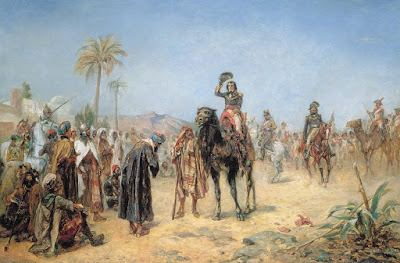 |
Napoleon's campaign also sparked European interest in Ancient Egypt, and created huge demand for
Orientalist art. |
 |
Punch Magazine cartoon parodying Sultan
Abdul Hamid II, showing hims as so
incompetent that he learns of his Empire's
reorganization from a posting resembling
an eviction notice. |
Desperate for to regain their prestige and to force the Sultan to follow through on earlier promises of constitutional reform, a group of young Turkish intellectuals and army officers staged a revolution in 1908. This brought an end to the autocratic rule of the Sultan, but replaced it effectively with a dictatorship led by Young Turk leaders who paid lip service to the Sultan. Despite some early government and military reform successes, the Ottomans continued their decline; after suffering humiliating defeat in the Balkan wars and losing their remaining North African influence to Italy and France, the dictators of Turkey known as the Three Pashas began seeking a European alliance to help them recover their lost prestige and territory. They found their ally in thew newly formed Empire of Germany. The alliance was convenient for both sides for several reasons. Germany was in a rivalry with England, France, and (especially important to the Turks), Russia, all of whom had expressed colonail interest in current or former Ottoman territory. The Germans hoped the Turks would be able to form a southern front against Russia in a theoretical war between the great powers, while the Ottomans hoped that Germany would be able to give them the decisive military edge to defeat their hated northern rivals. The alliance was formally ratified on August 2, 1914; 2 days later Germany's invasion of Belgium brought France and England into the First World War. Germany would become a massive arms and equipment supplier to the Empire throughout the war, and provided both officers and training to the outdated Ottoman military.
3. The War
World War I was a disaster for the Ottoman Empire. They managed to win a few victories (notably against the British Indian Army in Mesopotamia, modern Iraq), but spent most of the war on their back foot. For decades Arabs within the empire had been discriminated against, with even Arab officers in the Ottoman army frequently insulted, used in suicidal attacks, or sent to isolated garrisons with no chance for advancement. Arab nationalism had been on the rise as a result, which the British began to use to their advantage. Spurred by Anglo-French promises of an independent state, and made confident by British training and equipment and Entente promises of liberty, the Arab revolted cutting the empire in half. With the help of western advisers like Lawrence of Arabia and with British deliveries of weapons and explosives, the Arabs became a constant drain on the Ottoman war effort beginning in 1916.
 |
Arab soldiers during the war. In addition to the Bedouin guerrillas made famous by Lawrence of Arabia, the Arabs
did employ a professional army trained, equipped, and largely led by British and French officers. |
 |
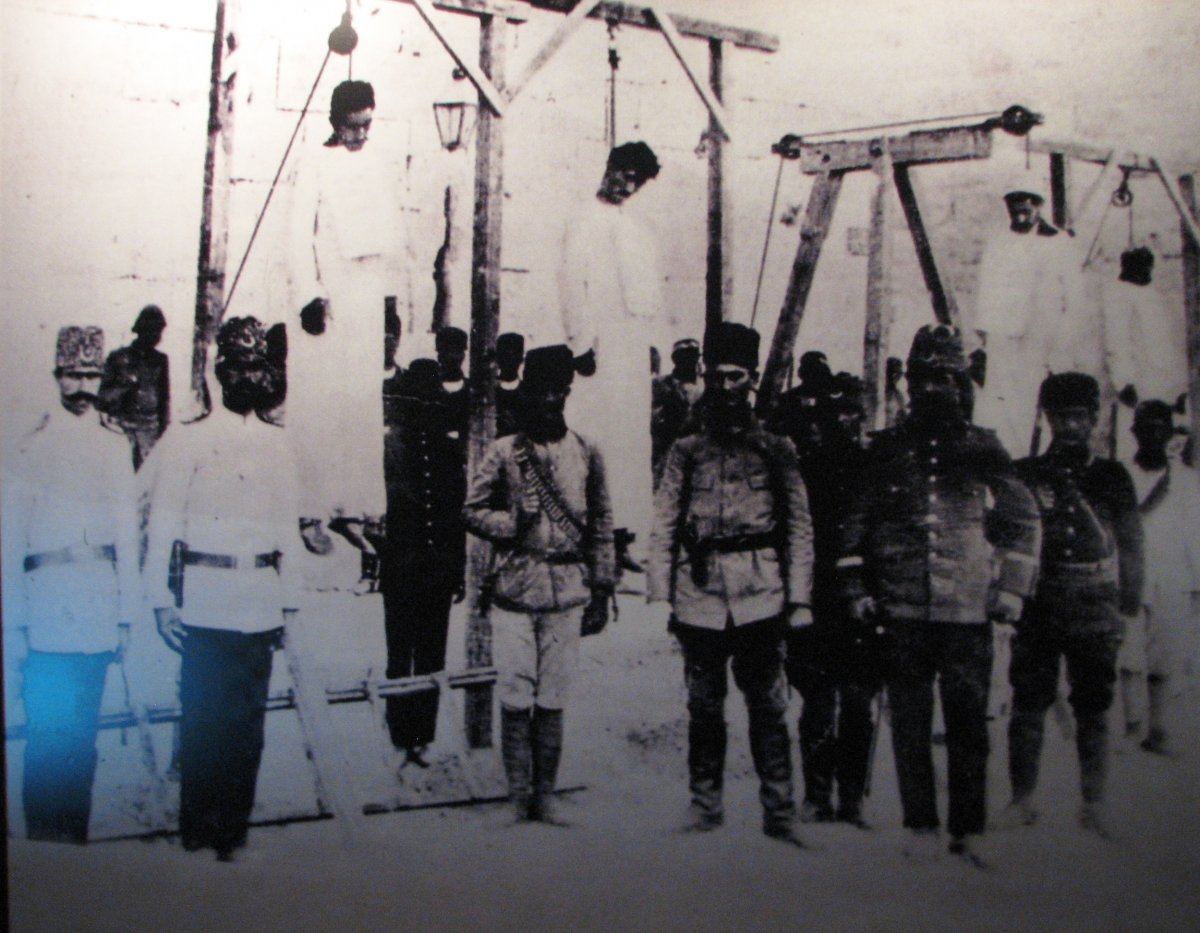
Ottoman officers pose with hung Armenian doctors in
Aleppo, 1916. |
Meanwhile, in 1915, the Armenian Genocide had begun. In brief, a combination of instability caused by Armenian nationalists, Turkish prejudice, and worry that the Armenians could act as a dangerous Christian fifth column caused the Turks to begin mass deportations and killing of Armenians. The genocide itself remains controversial and extremely complicated, but in short perhaps as many as two million Armenians were killed or died as a result of these killings and deportations. It also infuriated western nations, and relevant to this discussion, has caused continual international tension with Turkey and her neighbors to this day. The modern nation of Turkey does not recognize the Armenian genocide. I won't get into all of the details here, but in general most Turks acknowledge that massacres took place, but do not believe that the killings were an attempt at systematic eradication and do not believe that as many died during the genocide than is usually estimate. Further some Turks (including the current government) state that due to instability and violence caused by Armenian nationalists in the years leading up to the war, the deportations and executions were justified but botched by a handful of incompetents. This, as you might expect, is seen as extremely offensive to many nations, especially in Armenia and in nations with large Armenian expat communities.

The battles of the war were mostly disasters for the Ottomans, who suffered loss after loss. This was
especially true in the Caucuses. Enver Pasha, one of the Young Turk leaders, drew up a plan to attack Russia through the Caucus mountains and regain territory. Despite thinking himself a military genius, the attack was made in harsh terrain in winter the the Ottomans suffered appalling casualties from which the Ottoman military was unable to recover. Liman von Sanders had a poor opinion of Enver; not only was a he not a genius, von Sanders believed that Enver was actually dangerously incompetent and the two clashed frequently over matters of military policy. I should also note here that, due to his central role in the Armenian Genocide, Enver is an extremely controversial and loathed figure to this day. In Turkey after the war Enver and Mustafa Kemal also became political and military rivals, and eventually Enver was exiled. He wound fighting in the new Soviet Union, attempting to establish a Turkish state in the Muslim majority areas of the country. While fighting he was killed by Red Army troops in 1922.
 |
| Mustafa Kemal at Gallipoli |
The one bright note (from the Ottoman perspective) during the war was the Gallipoli. The entente decided to knock the Ottomans out of the war by attacking Constantinople during the Dardanelles campaign, a plan which First Lord of the British Admiralty Winston Churchill championed. Thanks to the brilliant leadership of local leaders, particularly a young officer named Mustafa Kemal, the Turks inflicted huge casualties on the British fleet and the predominantly Australian, New Zealander, and British Indian Army troops who were landed on the Turkish beaches. Kemal became a national hero, a role which was further reinforced in 1918. As the broken Ottoman army retreated from Arabia and the Levant, Arab and British forces harried their fleeing foes. Kemal managed to keep his 7th Army intact and formed them into a defensive line around Aleppo which he was able to hold until the war ended. Nearly all other Turkish forces in the area, including the 8th Army, were destroyed almost to a man.
4. The False Peace
The peace which ended the war had massive ramifications for the future of the world. In the Middle East, the Entene reneged on most of their promises; far from granting the Arabs their own large national state, the victorious western powers carved the former empire up. Britain cemented its hold on Egypt and the Sinai, and also took Palestine and Mesopotamia (modern Iraq). France took Syria and occupied southeastern Anatolia. Greece was given a large part of Thrace, including the historic Ottoman capital of Edirne, as well as numerous Aegean islands and a strip of the Anatolian coast around Izmir. Armenia became a fully independent nation, and Italy occupied most of Southwestern Anatolia. Most humiliating for most Turks, a strip of land around the Dardanelles (the area which the Turks had so successfully defended throughout the war) was occupied by an international coalition, as was the capital at Istanbul. The treaty went into effect in 1920 and despite never being formally ratified, had huge repercussions which can still be seen today. The treat laid the groundwork for the formation of the modern state of Israel (which would grow out of the British mandate in Palestine), and formed most of the borders that modern Middle Eastern countries conform to.
 |
| Partitioning of the Empire. Most Arab areas south of this went over to British control. |
While most Turks realized that the empire was lost forever, the occupation by foreign troops was unacceptable, particularly in the capital and the Dardanelles where so much bled had been shed. Mustafa Kemal, who since the end of the war had served in a number of roles reorganizing the defeated military, quickly decided to take action, In June 1919 he issued a declaration which stated that, as a result of the partitioning and occupation of the country, Turkish independence was at risk. A month later he resigned his commission, putting him in danger of execution both by occupying authorities and the rump Ottoman government. In September he assembled a congress in Sivas, one of the few cities not to be occupied, and at this meeting the delegates elected him to be effectively the head of the executive committee of the congress. In December the final parliamentary elections of the Ottoman Empire were held, and Kemal's party took a majority of seats; in early 1920 this body was finally dissolved by the occupying British.
As a result of this, Kemal called for new national elections to create a Grand National Assembly. When this assembly met in 1920, it essentially created a second government for Turkey, as the occupying powers still recognized the Ottoman government led effectively by Grand Vizier Damat Ferid Pasha who signed the above treaty. This enraged the GNA members, and Kemal called for the assembly of an army to defend Turkey.
5. War of Independence
Early on, Kemal's forces appeared to be in dire straits. In the west they were opposed by the remaining Ottoman loyalist armies, backed up by the occupying Entente forces while in the west they were also facing the new Armenian army, who had occupied territory granted to them in the treaty but which the GNA did not recognize as theirs.
 |
| Turkish leaders during the War of Independence. Mustafa Kemal is in the front row, third from the right. The man fourth from the left in the funny hat is a Soviet military adviser. The Soviets pumped resources into the war hoping to keep the area unstable and perhaps leaving it open to Communist revolution. |
 |
Turkish soldiers in a trench before the
battle of Dumlupinar. |
The war which followed, the Turkish War of Independence, raged until late 1922. After successfully invading
Armenia and reclaiming disputed territory, the GNA faced an invasion from Turkey as they moved to occupy the areas in western Anatolia they had been granted at the end of the war. On August 5, 1921, after the Greek army was only 80 kilometers away from the frontier held by GNA forces, Mustafa Kemal was appointed as Commander in Chief of all GNA forces. After halting the Greeks at the Battle of the Sakarya River, the allies sought to negotiate a modified but still punishing version of the treaty with the GNA government (now based in Ankara), but they were refused outright. Later that same month Kemal launched a sweeping attack on the Greek occupied territory in Anatolia. On August 30 1922 the Kemal's forces swept the remaining Greeks out of Anatolia in the Battle of Dumlupinar, and his forces regained control of the city of Smyrna by September 9. The next day Kemal sent a telegraph to the new League of Nations, informing them that the Turkish population of the country had been so humiliated and enraged that he could not keep them under control. Now facing both a well-organized and led national army as well as the prospect of a brutal insurgency, the western powers sought peace and the GNA gained formal control of Turkey.
6. The Republic of Turkey
On November 1, 1922, the GNA's newly founded parliament abolished the sultanate and the Ottoman Empire ceased to exist. The Treaty of Lausanne, made with the occupying powers, established the recognized sovereignty of the new state and finalized its borders. On October 29, 1923 the Republic of Turkey officially came into being, with Mustafa Kemal as its first president and Ankara as its new official capital.
 |
| Ataturk during his presidency |
Kemal began an aggressive campaign of reform, modernization, and westernization. Traditional forms of
dress such as the fez were banned. Women were given political and civil rights unheard of up until that point. The writing system of the Ottomans had been based on Arabic, but writing in the Turkish language was clunky with this alphabet due to certain sounds in Turkish. Therefore, it was replaced by a new system based on a modified form of the western Latin alphabet. The country was secularized, and a firm division of church and state was established, while things like alcohol and freedom of religion were instituted. All Turks were also expected to take on a surname in the western style; Mustafa Kemal was granted the surname "Ataturk" by parliament, meaning Father of Turks in 1934. By the eve of the Second World War Turkey had made large strides in modernization, though it remained functionally a dictatorship first under Ataturk and then under his successor Ismet Inonu, until the latter was defeated in free elections in 1950.
Ataturk's legacy cannot be understated when trying to understand modern Turkey. Thanks in part to a personality cult which was fostered around him during his long presidency, and in part thanks to the belief among Turks that he saved the country from becoming a victim of colonization, Ataturk remains wildly popular today. Laws exist prohibiting the insulting of Ataturk (in a country with otherwise fairly liberal free speech laws), and every house, business, bus, and building has a photo of the man.
 |
| The author took this photo in 2008. It shows a massive photograph of Ataturk flanked by Turkish flags over looking the city of Istanbul from a nearby hill. |
7. A World at War
 |
| Izmet Inonou, leader of Turkey in WWII |
During World War II, Turkey remained neutral and profited from both sides. After the First World War ties
with Germany had been close, and the Nazis attempted to rebuild the old alliance but to no avail. Despite this, the two nations remained firm trading partners. In 1939, unsure of Hitler's intentions, Turkey signed a pact with Britain which stated that Britain would come to Turkey's aid in the event of a German attack on Anatolia, but this never happened and Turkey remained an important supplier of Chrome and other materials to both the Axis and the Allies. In August 1944, when German defeat was unavoidable, Turkey broke off relations and began growing closer to the allies. In February of 1945, only months before the end of the war in Europe, Turkey declared war on Germany and Japan (Italy had already been defeated). While Turkish troops never saw combat, they did continue to supply the allies and this allowed Turkey a seat at the table in the formation of the United Nations.
During the War of Independence, the GNA had received supplies and money from the Bolsheviks, who had hoped to cause further instability among the western allies. However, beginning in the 1930's under Stalin the Soviet Union became increasingly aggressive and relations between the old rivals worsened. After World War II, the Soviets even went as far as demanding the establishment of Soviet naval bases on Turkish soil, especially in the straits around Istanbul. Worried about growing Soviet influence, American President Harry Truman gave a speech on March 12, 1947 which established the Truman Doctrine. This doctrine would provide massive military and economic support to Greece and Turkey, and implied support for other nations as well. The speech is often considered to mark the starting point of the Cold War, and Turkey was at its center.
 |
| Turkish soldiers in Korea during the war. The Turks were supplied with American equipment and fought under American command. |
The United States kept its word, and money and military equipment flowed into Turkey. Turkey was a loyal ally; in 1950 the Republic sent forces to aid the United Nations forces in the Korean War. At the Battle of Wawon, the Turkish Brigade led a rearguard action which slowed the North Korean army and cost the brigade dearly in the loss of men and equipment. At the battle of Kunuri the brigade lost 15% of its combat strength. Then at the battle of Kumyangjang-Ni in January 1951, the brigade saw off a Chinese army more than three times its size. The unit received the Distinguished Unit Citation from the United States, and by the end of the war 721 Turks had been killed and more than 2,000 wounded. In acknowledgement of their contribution, Turkey was invited by the United States to join NATO, which they did in 1952.
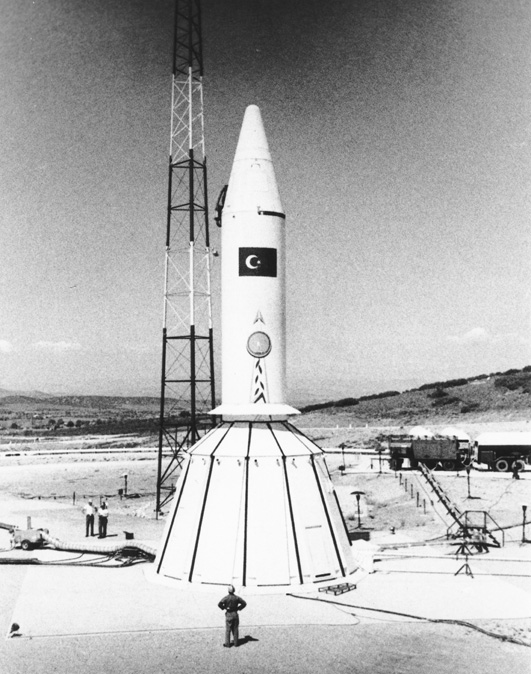
Throughout the Cold War, Turkey remained a critical ally of the United States, which began establishing air bases in the country. In 1962, the United states began deploying Jupiter ICBM's equipped with nuclear warheads in Turkey. Concerned and needing a show of Force, Soviet Premier Nikita Khrushchev began the construction of Soviet missile cites in Cuba, leading to the Cuban Missile Crisis (that's right, despite most high school level history courses implying the Soviets were responsible, we built threatening nuke bases first!). At the peaceful conclusion of the crisis the missiles were withdrawn, but American troops remained in country.
 |
| American Jupiter ICBM in Turkey in 1961, bearing a Turkish flag. |
In the 1950's, the Greek and Turkish populations of the island of Cyprus began having increasingly heated ethnic tensions which turned into violence. In 1974 the military Junta in Greece managed to stage a coup on the island with the aim of an annexation of the island to Greece down the road. Concerned about naked Greek aggression, and justifying themselves by claiming they were protecting the Turkish minority on Cyprus, Turkey invaded the island and established a Turkish puppet republic. The republic exists today and Cyprus remains divided, though only Turkey itself recognizes the Turkish Republic of Northern Cyprus today. The invasion and subsequent occupation was criticized by most world governments, and the issue remains a sticking point in Turkish foreign relations, particularly with Greece and the European Union.
 |
| Map showing the ethnic population distribution between Greeks and Turks on Cyprus before the 1974 Coup and today. |
8. Turkish Coups
Despite the establishment of a multiparty republican democracy in Turkey after World War II, the country has faced periods of instability. Turkey has seen three successful and several unsuccessful coup attempts. The first, in 1960, was staged by Turkish military officers who had been trained in the United States. Truman Doctrine money was running low, and the then prime minister Adnan Menderes had planned to visit Moscow. This led to fears that he was attempting to realign the nation towards the Warsaw pact and the military intervened. Menderes was executed for treason, and the military effectively controlled the nation until 1965. In 1971, facing internal strife and an unpopular government, military leaders issued a "coup memorandum" warning the civilian government to improve the situation, which led to the fall of the then-current administration. In 1980 General Kenan Evren staged another coup. Martial law was established and despite handing the government back to civilian authorities two years later, the military continued its effective control of politics for some time after.
 |
| Adnan Menderes and his staff are arrested by Turkish military police. Note that the Turkish military is still using mostly American equipment and weapons. |
The remainder of the 1980's were a flowering period for Turkey; under the leadership of Turgut Ozal and his Motherland Party the economy was liberalized and the standard of living for the average Turkish citizen improved dramatically. However, the Motherland party also advocated certain conservative social values, which some argue opened the door for radical Islamist sympathizers who until then had been virtual pariahs in the Turkish political stage.
 |
PKK Kurdish rebels pose with their Communist-Inspired
flag in the Turkish city of Diyarbakir in 2015. |
During the 1980s the conflict with the Kurds truly began as well. The Kurds had been an ethnic minority throughout the Ottoman period, and had faced periods of repression and growth during the Republican period. With Turkey's entry into NATO, the Soviet Union began equipping and training Kurds in an effort to destabilize Turkey. However, the situation remained fairly stable until the 1980 coup, when Evren's military government launched a brutal crackdown on leftist organizations and individuals, especially in Kurdish areas. This led to a series of Kurdish terrorist and military attacks on Turks, and the conflict has been going on ever since. The Kurds and particularly the PKK are seen by terrorists by many Turks, especially as they have historically depended on suicide and IED bombings, hostage taking and kidnapping, and guerrilla attacks on Turkish conscript soldiers and police officers. The Kurds meanwhile see the Turks as an oppressive occupying force bent on preventing Kurdish independence. Both sides have committed atrocities, and while things began to calm down in the 2000's, the rise of ISIS has reignited issues on the border.
In 1987 the southeast of Turkey was put under emergency martial law in part due to increased conflict with the Kurds. Turkey was politically unstable throughout the 1990's, and things came to a head in 1997 with Necmettin Erbakan's government. He was accused by the military of supporting Islamist policies which were counter to the secular law of Turkey, leading to his resignation to prevent another coup. Several political parties were banned in the aftermath, and in 1999 a coalition between a center-left and far right nationalist party formed a government which instituted economic reforms and human rights legislation, but which was mostly ineffective due to the radically differing ideologies of the two parties forming the coalition.
9. Turkey Today
In 2002 the former Mayor of Istanbul, Recep Erdogan, came to power at the head of the Justice and Development Party (the AKP). The party has won every election since, but has become increasingly controversial abroad. Turkey attempted to join the EU in the early 2000's, but due to human rights and economic issues Turkey was rejected and its bids to join the EU since then have stalled. EU leaders cited a draconian justice system, government instability, economic issues, and human rights abuses against Kurds and other minorities as reasons for the rejection, though some Turks saw it simply as a matter of western arrogance or racism.
 |
| Erdogan, the current leader of Turkey |
The AKP has continued to improve the economy of Turkey, but has become increasingly totalitarian. Several alleged coup attempts have taken place since they came to power, but many view these as excuses for the party and Erdogan to simply liquidate rivals or threats to their power. The party relies heavily on the rural vote in Turkey, and has begun to increasingly use Islamist language of a type not seen before in mainstream Turkish politics. Due to Ataturk's major emphasis on secularization, Turkish politics and religion have long been heavily seperated, but the AKP has begun to break some of these barriers down.In 2013 protests erupted in the Taksim neighborhood of Istanbul as young people gathered to show their support for Turkish secularism and democracy. The protests were brutally put down by riot police, and 11 protesters were killed. This was the first time that many westerners became familiar with the increasing repression faced by the Turkish public.
 |
| Riot police attack Turkish protestors |
In 2016, a coup was staged citing increasing censorship and a breakdown of secular values in government. This was easily put down, and some commentators believe that the coup was actually a false-flag operation to allow Erdogan to take more firm control of the government. Since the coup a series of purges have been launched which have resulted in the firing or arrest of hundreds of thousands of politicians, teachers, academics, civil service workers, and journalists. Amnesty International claims that many of these have been victims of torture while under detention, and many have been charged with belonging to terrorist groups on clearly fabricated evidence.
 |
| Turkish citizens pose on a surrendered tank in the aftermath of the failed 2016 coup attempt in Istanbul. |
Turkey's traditional 20th century alliances have also begun to break down. This really started in 2003 with the American invasion of Iraq. Erdogan's government refused to allow American forces to use Turkey as a launching off point for ground attacks, or even as a launching point for bombing and aircraft missions. In the wake of the instability after the invasion, Turkey saw an increase in problems with Kurdish militant groups, some of whom were armed by the US to fight the Iraqi insurgency and others who know had more breathing room now that they could retreat into a less hostile Iraq. Turkey did eventually commit troops to Iraq for peacekeeping purposes, but the strain between the Us and Turkey remains.
 |
| Turkish artillery in firing positions on the Syrian border. |
The Arab spring in 2012, the Syrian civil war, and the rise of the Islamic state have further complicated matters in Turkey. Erdogan's government has been accused of supporting Islamist groups in Syria either directly or by funding them indirectly through the purchase of oil from Islamic State held refineries. Turkish troops have also skirmished with Russian forces operating to support the Assad regime, and Turkish-trained and backed militias have shot down Russian aircraft, killing pilots. Despite this tension with her old rival, Turkey seems to be moving closer to Russia as Erdogan looks for alternatives to the United States.
Conclusion
 |
Andrei Karlov lies dead behind his
shouting assassin, 2016. |
As you can see, Turkey has an incredibly complex history. Despite its status as one of the oldest
democracies in the Muslim world, it is constantly threatened by ethnic strife, nationalist movements, religious extremists, militant religious groups, and the strategic needs of foreign powers. Currently the Erdogan government is becoming increasingly repressive, even as Ankara and Istanbul suffer attacks from Islamic extremists. As the meeting point of the Middle East, Europe, and Russia, Turkey finds itself in dire straits. Most recently, in December 2016 an off-duty Turkish police officer assassinated Andrei Karlov, the Russian ambassador to Turkey during a press conference in Ankara. The assassin shouted Islamic mottoes and called on witnesses to "remember Aleppo" (in reference to Russian bombings in that city), but Russian President Vladimir Putin claimed that the assassin had been motivated by an urge to damage Turkish-Russian ties.
I'm not sure what the future holds for Turkey, and it's difficult to say where it is going to go. While becoming increasingly sympathetic to Islamists, Turkey is also strengthening ties to Russia. At the same time, only hours before this article was posted, Turkey agreed to sign a multi-million dollar arms deal with Great Britain. Pundits have also noted that Turkey looks forward to better relations with the United States under President Trump, despite Erdogan's criticism of Trump's policies on Muslim immigration. Turkey is complex and fascinating, and hopefully you have a little bit more of an understanding about their current and historical political situation and why they seem so unstable today.
Further Reading
Lord Kinross,
Ottoman Centuries. This book, while a little older, is still considered the gold standard for a basic, in-depth look at the history of the Ottoman Empire.
Caroline Finkel,
Osman's Dream: The History of the Ottoman Empire. This is essentially an in-depth chronology of the Ottoman Empire. It offers little analysis, but is good to get a more in-depth look at the empire.
Carter Findley,
The Turks in World History. If you want an extremely detailed look at the history of the Turks, then look no further. This is a fairly advanced read geared more towards academics, but it's worth a look if you have a serious interest!
Eugene Rogan,
The Fall of the Ottomans: The Great War in the Middle East. This is my favorite book on the final years of the Ottoman Empire, Rogan does a great job of mixing both political and military history and manages to keep things fairly simple.
Andrew Mango,
Ataturk: The Biography of the Founder of Modern Turkey. There are a lot of Ataturk biographies out there, but I like this one because it manages to stay relatively unbiased and is detailed without being an extremely difficult read.
Stephen Kinzer:
Crescent and Star: Turkey Between Two Worlds. A great book on modern Turkish history, this is updated fairly regularly with new editions to boot!
Andrew Finkel,
Turkey: What Everyone Needs to Know. If you want a much more detailed, longer version of the post you've just read, this is the book for you!

 palace was begun by Henry VIII's favorite adviser Cardinal Thomas Wolsey who envisaged it as the greatest country manor in England. In 1529 he gave it as a gift to Henry in an attempt to save his own skin but soon fell from favor anyway. It became a favorite of Henry's, and served as a royal residence until the reign of George II, undergoing a renovation in the 1600's to make it a rival of Versailles. The project was never finished and this left the palace a curious mix of styles. Today Hampton Court is no longer used as a residence by the royal family, but a suite of apartments still occupies some of the buildings. These are given to revered civil servants or friend of the royal family as a form of state gift; as an example, the widow of the founder of the scouting movement was granted an apartment in the 1950's. Today the palace sits in the outer suburbs of London, and sits surrounded by neighborhoods and parks. Its packed with history but because the palace is a bit out of the way it doesn't draw the huge crowds you might expect.